
Democracies must learn to defend themselves
A rough line of thought for discussion
Suppose the strongest democracies decided to form a defence alliance of their own. Without the United States and without countries that may currently be allies, but are not full democracies.
What would our first reaction be?
Interesting — let us explore how that might work.
Or:
Impossible — we already have NATO and the European Union.
That difference in response is essential. Do we regard existing organisations as instruments that must be adapted to changing circumstances, or as immutable parts of reality?
If we want to think seriously about the state of the world, we must distinguish between what is necessary and what has come to seem self-evident merely through system habituation.
Taking democracy literally
Democracy begins with the citizen. Through elections, citizens confer political power on their representatives. That is the democratic mandate. Other organisations may be knowledgeable, influential and valuable, but that does not give them a democratic mandate.
In the Netherlands, the chain of government essentially runs from:
citizen → House of Representatives → government → ministries.
Citizens elect the House of Representatives. A government can function only as long as it retains sufficient parliamentary confidence. Ministers then direct their ministries and are accountable for their actions.
Alongside them are public bodies and organisations with legislative, supervisory, advisory, legal or societal responsibilities. They may be valuable and even indispensable, but influence, expertise, oversight and democratic mandate are different things.
If we no longer make that distinction clearly, everything will eventually be called “democratic”. We will then also lose the ability to determine which states are truly democratic and which countries we are willing to grant unconditional access to our military, economic and digital infrastructure.
A security alliance of democracies must therefore begin with countries in which citizens can genuinely confer, control and withdraw political power.
Not more money, but a different defence
When threats increase, calls for more defence spending follow almost automatically. But before we put more money into existing organisations, doctrines and weapons systems, a more fundamental question must be asked:
Do we still have the right kind of armed forces?
The war in Ukraine has shown that drones are not merely another weapons system alongside existing weapons. Drones are changing reconnaissance, communications, command, logistics, artillery, air defence and the relationship between cost and military effectiveness.
Robert Brovdi, better known as Magyar, has warned from direct Ukrainian combat experience that NATO countries are not prepared for drone warfare. Ukraine is attacked every day by hundreds of relatively inexpensive attack drones, sometimes combined with large numbers of missiles. No Western military can counter that for long, or at an economically sustainable cost, using only traditional air-defence systems.
The answer cannot be: more money for the same armed forces.
The answer must include:
- new doctrines
- a different organisation
- short development and production cycles
- mass production of inexpensive systems
- inexpensive defences against inexpensive weapons
- rapid incorporation of experience from the battlefield
- and an industry capable of scaling up immediately during a conflict
Ukraine should not be left at the sidelines as a recipient of aid, but should take a place at the design table as one of the most important sources of knowledge. The country can provide knowledge and systems, but it will not be able to supply all of Europe with experienced military personnel. We must therefore absorb that knowledge now.
We could have known
On 5 June 2023, I wrote to the Standing Committee on Defence of the Dutch House of Representatives about Ukraine’s urgent need for inexpensive reconnaissance and attack drones.
The immediate cause was an appeal for donations by that same Magyar. His units needed drones costing from a few hundred to a few thousand euros. The absence of those drones was demonstrably costing Ukrainian soldiers their lives. While Europe discussed large and expensive weapons systems, Ukrainian commanders had to raise money through YouTube and social media for equipment that was already transforming everyday warfare.
My question to the committee was simple: could the Dutch government provide structural support for such requests, and where could a Ukrainian commander submit such a request?
No answer followed that led to anything recognisable.
To this day, money is raised on social media for power cables, tyres, generators, tourniquets and other basic supplies. Not because these items are scarce or unaffordable, but because our vast aid system is apparently unable to deliver them reliably where they are needed.
This does not reflect a lack of money or goodwill, but a system failure. The same system that recognised the significance of drones too late is still unable, years later, to translate simple signals from the front line into timely supplies.
The significance lies not in that one letter or in the question of who proved right in hindsight. The letter demonstrates that the information was available, came directly from combat experience and reached the democratic system.
The information then disappeared from view.
Three structural problems come together here:
System habituation: a new war is assessed through yesterday’s organisations, doctrines and procurement procedures.
Progressive forgetting: early signals disappear into archives without later being retrieved and tested against new developments.
Failing democratic knowledge transfer: information reaches elected representatives, but is not demonstrably converted into a living dossier connecting citizens, members of parliament, government, ministries and the armed forces over time.
NATO countries could see drone warfare coming, but failed to adapt their armed forces in time.
The ability to criticise the framework
Officers are rigorously selected for their ability to learn quickly and recognise connections. In terms of Learn, Associate, Criticise, Act, they necessarily score highly on Learn and Associate.
That selection was not directed towards Criticise and Act. Within a military command structure, those qualities are also constrained. Criticism ends where an order takes effect, while action takes place within the scope permitted by command and control.
Outside that command structure, the situation is different. The knowledge and analytical ability remain, but can now also be used to criticise the framework itself.
The essential question is therefore not how we can repair NATO. The question is what security architecture democracies need under present circumstances.
Existing structures, people and resources may be reusable. But our thinking should not be restricted in advance by the perceived need to preserve an existing organisation.
The continued existence of NATO should not come first. The defence of our democracies should.
A Democratic Alliance
The strongest democracies should form a new Democratic Alliance — DeAl. A deal between democracies.
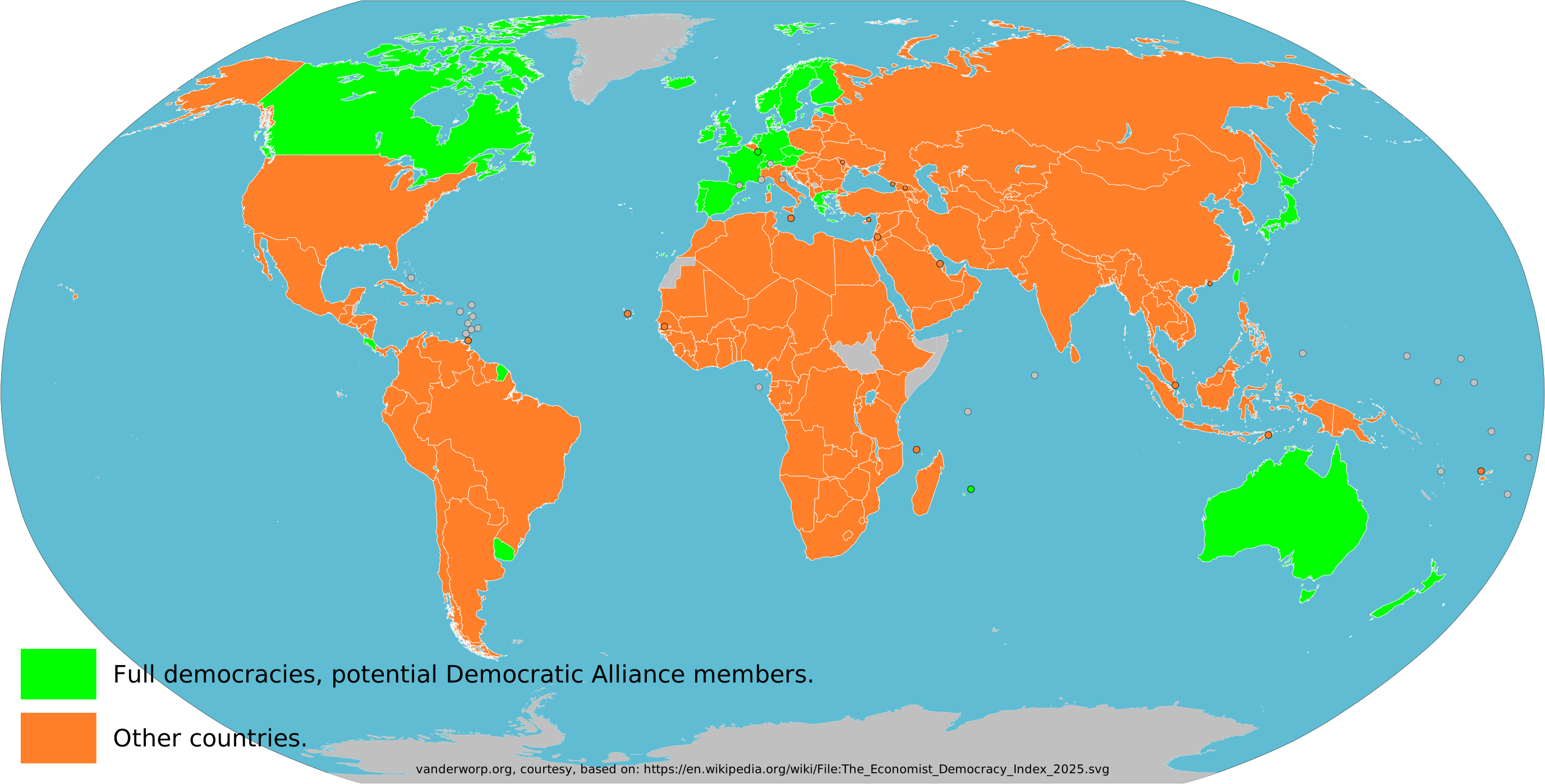
Participation should be determined not by geography, historical alliances or membership of NATO or the EU, but by demonstrable and enduring democratic quality.
The DA should begin with a small, strong core: countries that are politically stable, genuinely uphold the democratic rule of law and are willing to bear responsibility. Accession should follow only after a country has met clear criteria over time. Democratic backsliding must have consequences for access to the alliance’s decision-making, technology and infrastructure.
The DA is therefore not an exclusively European project. Strong democracies in Asia, Oceania and North and South America belong to the same political community. What connects these countries is more fundamental than their location: citizens confer political power and can withdraw it again through elections.
The alliance would defend not only territory, but also the ability of democracies to continue existing independently.
Not Trump, but the system behind Trump
The unreliability of the United States cannot be attributed solely to Donald Trump.
A democracy that makes its security dependent on a single American election has seriously neglected its own responsibilities. Moreover, Congress, political parties, government organisations and a large part of the American population have shown themselves willing to accept that structural unreliability.
Behind Putin stands a network of criminals. His power is sustained by the siloviki, the security services, economic self-interest and a political culture in which imperialism and oppression can thrive.
Focusing exclusively on Trump and Putin means underestimating the systems that produce them.
Cooperation with the United States remains desirable. Dependence on the United States does not.
Article 5 does not provide automatic defence
Article 5 of the North Atlantic Treaty obliges every member to take such measures following an attack as it deems necessary. This may include the use of armed force, but the article does not provide an automatic military response independent of national political decision-making.
As long as political will and mutual trust exist, that wording may be sufficient. But when the reliability of the most important military partner becomes uncertain, the difference between a treaty promise and guaranteed defence becomes painfully clear.
The DA must organise this differently. Not merely a promise to consult one another after an attack and then determine nationally what is necessary, but defence arranged and organised in advance:
- joint command
- pre-assigned units
- shared information systems
- available stockpiles
- prepared production capacity
- rehearsed decision-making
- and a credible military response that cannot be blocked by a single participant
NATO promises defence. The DA guarantees that the defence will actually be carried out.
Zero critical dependence
The DA’s first strategic objective must be to reverse all critical dependence on the United States and other external powers until it reaches zero.
This applies first of all to military information. An independent alliance cannot depend on American satellites, intelligence, cloud systems, navigation, communications, software or permission to use weapons systems.
But genuine sovereignty goes much further.
If you depend on others for weapons, chips, raw materials, energy, medicines, digital infrastructure or food, you can defend your democracy only for as long as those others allow it.
The DA as a whole must be self-sufficient in:
- satellites, ISR and secure communications
- navigation and targeting information
- cloud services, software and digital infrastructure
- chips and the entire production chain around them
- lithography technology, including the knowledge and systems surrounding ASML
- rare earth elements and other strategic raw materials
- energy and fuels
- medicines and medical equipment
- food, water and fertiliser
- transport, ports and payment systems
- defence industry and strategic stockpiles
Not every country needs to be able to produce everything. But the DA as a whole must.
From ASML to potatoes: everything required for long-term independent operation forms part of the security architecture.
A publicly controlled industrial base
Strategic production cannot be left entirely to companies that are necessarily driven by returns, quarterly results and shareholder value.
Defence companies, chip production, satellite systems, energy supplies and other critical infrastructure may therefore be organised under partial or complete public ownership. This could take the form of golden shares, joint majority holdings or companies wholly owned by the participating countries.
The origin of capital also matters. Shareholders bring in more than money: they acquire control, access to knowledge and influence over strategic decisions. Capital from countries without democratic control is therefore not politically neutral and has no place in companies essential to the security of the DA.
Shared standards, procurement and production must prevent the DA from becoming a collection of dozens of national defence markets and incompatible systems.
The decisive question is not whether this arrangement is entirely consistent with free-market principles. The question is whether democracies can control their own production capacity during a crisis.
Interlude — The Staatse Affuitmakerij
In 1679, the Netherlands established the Staatse Affuitmakerij, a state-owned gun-carriage works. The company later evolved into the Artillerie-Inrichtingen and eventually Eurometaal. More than three centuries later, Eurometaal closed in 2003, leaving the Netherlands without a domestic ammunition factory. In 2026, a private initiative emerged to resume ammunition production in the Netherlands under the historic name.
Privatisation and closure seemed defensible as long as large-scale war was considered unlikely. Now that the Netherlands once again needs domestic production capacity, we can see how easily strategic knowledge disappears and how difficult it is to recover. A factory can be closed as soon as it ceases to be profitable, but national security cannot wait until reopening becomes profitable again.
Anything indispensable to the continued existence of the democratic rule of law must not depend on the willingness of a commercial supplier, a foreign shareholder or a potentially hostile state.
An independent nuclear deterrent
An independent alliance ultimately also requires an independent nuclear deterrent.
France and the United Kingdom already possess nuclear weapons. Their capabilities could form the basis of a joint DA doctrine and an explicit deterrence guarantee for the participating countries.
This does not mean that every country should have nuclear weapons of its own. It does mean that the participants must share responsibility for financing, security, political control and further development of the deterrent.
Decision-making on this subject requires exceptionally careful safeguards. But the fundamental question is simple: can an independent alliance continue to depend for its ultimate defence on a country no longer considered fully reliable?
The answer is no.
Russia is only the first stress test
Russia exposes our military vulnerability. China could expose the full extent of our societal dependence.
China’s economy, population and industrial capacity are many times larger than Russia’s. A confrontation with China would not be fought solely with frigates, aircraft and missiles. It would affect raw materials, chips, telecommunications, ports, data, energy, payment systems, production chains and political influence.
We must be able to defend ourselves militarily against Russia.
Against China, the democratic world must be able to continue functioning independently.
The DA must therefore be a defence alliance, an industrial bloc, a digital legal order and an economic security community at the same time.
The JEF as a practical starting point
The Joint Expeditionary Force demonstrates that military cooperation without the United States is possible. The JEF brings together the United Kingdom, the Netherlands, the Nordic countries and the Baltic states, and already provides concrete military cooperation and collective deployability.
The JEF could therefore serve as an operational starting point for the DA.
However, the JEF cannot automatically serve as the political core of the new alliance. Not all JEF countries are full democracies, while many strong democracies lie outside the JEF.
Use what already works, but do not allow the final model to be determined by the incidental composition of an existing framework.
NATO and the EU will resist
Both NATO and the European Union will probably regard a Democratic Alliance as a competitor.
NATO will warn of duplication, fragmentation and weakening of the existing alliance. The EU will have difficulty with an organisation that selects countries according to democratic quality rather than geography and formal EU membership.
Ministries, branches of the armed forces, defence companies and lobbying organisations will also defend existing responsibilities, budgets and positions. Organisations never assess new ideas solely on their merits, but also according to the consequences for their own influence and continued existence.
That resistance does not make the DA unnecessary. Instead, it clearly illustrates why renewal is so difficult to achieve from within existing structures.
The DA will also come into conflict with parts of the European internal market. A shared strategic industry and digital infrastructure cannot be made accessible to external powers through a single less reliable EU country.
If the free movement of goods, capital, technology or data undermines the security of the DA, the participating EU countries must jointly force change. The European Union must adapt to the new security reality, not the other way around.
The DA may initially emerge alongside NATO and the EU and make use of their effective components. But the DA must be able to decide and act independently. Otherwise, it will once again become dependent on the organisations whose limitations it is specifically intended to overcome.
The real choice
The choice is not between loyalty to NATO and its reckless dismantling. Nor is it between spending more or less on defence.
The real choice is:
Do we continue to base our security on organisations, dependencies and weapons systems from the past, or do the strongest democracies jointly build a new security order with a single objective: to remain independent under all circumstances?
A democracy unable to feed, inform, arm and govern itself digitally ultimately exists only with the permission of others.
Together, the strongest democracies possess the knowledge, economy, technology, population and military capacity required to end that dependence. What is missing is not the ability, but the willingness to abandon existing dogmas.
Not more money for yesterday, but a different organisation for tomorrow.
Not the United States as the indispensable centre, but cooperation between independent partners.
Not the preservation of organisations as an objective, but the continued existence of the democracies for which those organisations were once created.
NATO belongs to a world that is disappearing. It is time for an alliance in which democracies no longer entrust their security and continued existence to others.